Flow Weather - Live Radar Home
- 4.3
- Rating
- 1.00M
- Installs
- Free
- Price
 Analysis by App-foxy
When I need to decide whether to walk, cycle, leave laundry outside, or simply carry an umbrella, I want more than a single temperature number. I want a quick view of what is happening now and a practical sense of what may happen next. Flow Weather - Live Radar Home is built around that need, combining weather forecasts with a live radar map in a free Android weather app from ArgonIsBlue.
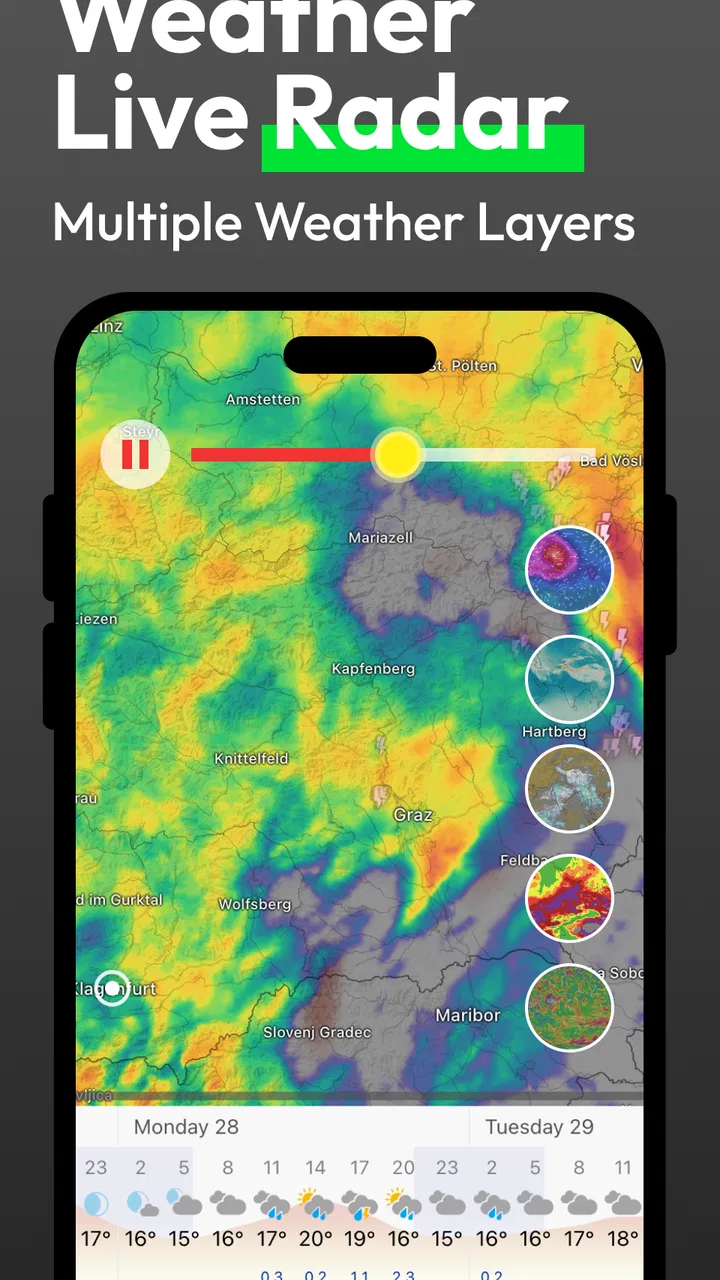
After spending time with it, I found its strongest idea is the connection between a familiar forecast screen and a more visual radar view. Instead of treating weather as a list of figures, it gives me a way to compare the forecast with the movement of weather across the map. That makes it especially useful when conditions are changing and a simple “partly cloudy” label feels too vague.
The app is available to everyone, costs nothing to use, and supports Android 6.0 or later. Its current version is 1.0.8, and it has already passed the half-million-install mark with an average rating of 4.5 from roughly three thousand ratings. Those figures suggest that it has found an audience, while the smaller review count means I still judge it mainly by how well its central workflow works in daily use.
You May Also Like

 Blood Strike: 2.5 Anniversary
Blood Strike’s Loadouts Turn Every Drop Into a Tactical Gamble
A close look at Blood Strike’s custom loadouts: how fast access to signature weapons reshapes its battle royale rhythm, rewards preparation, and narrows the gap between fights.

 Pandora - Music & Podcasts
Pandora’s Music Is Easy to Start, but Harder to Recover
Pandora’s strength is its low-effort path from a seed to a station. Its weak spot is how much confidence it asks you to place in connection, setup, and quiet recovery.

 8 Ball Pool
 Is Built on Rivalries, Rematches, and Routine
A close look at the rivalries, rematches, shared routines, and unanswered safety questions that turn a quick pool match into a persistent mobile community.

 Samsung Music
’s Quiet Strength Is Playing What You Already Own
Its reach comes less from spectacle than from dependable access to a personal library. That simplicity is both the app’s strongest retention engine and its ceiling.

 AccuWeather: Weather Radar
AccuWeather Review: A Quick, Clear Forecast for Everyday Decisions
For everyday plans, the best forecast is the one you can understand quickly. AccuWeather makes rain timing, radar, and local conditions easy to act on, with a few trade-offs.

 Hill Climb Racing
Why Hill Climb Racing Still Turns Crashes Into One More Run
A tiny car, a bumpy hill and one more upgrade: Hill Climb Racing keeps resurfacing because its simple chaos makes every near-miss feel personal.
More From Our News Desk



From a vague weather question to a useful decision
My starting condition was ordinary: I had somewhere to be, but the sky outside did not tell the whole story. A weather app has to answer two different questions. First, what is the expected weather for my location? Second, is rain or another weather system actually moving toward me right now? Flow Weather handles those questions through two related views rather than forcing everything into one crowded screen.
The forecast is the natural first stop. It gives me the broad outlook I need before making a plan, while the radar map adds context when the forecast alone is not enough. This is a sensible arrangement because I do not need a map every time I check the weather. Most checks are quick, and the forecast should remain the starting point. The map becomes valuable when timing matters.
I also like that the app’s identity is clear. It is not trying to become a news feed, a travel planner, or a general-purpose dashboard. ArgonIsBlue has focused the experience on weather forecast information and live radar. That narrow purpose helps the app feel easier to understand than weather tools that surround a basic forecast with unrelated cards and alerts.
The first check: reading the forecast without overthinking it
My usual workflow begins with the forecast because it is faster than opening a map. I check the expected conditions, then decide whether I need more detail. For a routine morning commute, that may be enough. If the forecast suggests rain around the time I plan to leave, I move to the radar rather than guessing from the icon.
This two-stage habit is one of the app’s most useful practical lessons. The forecast is good for planning the shape of the day; the radar is better for judging whether a nearby weather pattern deserves attention. Treating the radar as a replacement for the forecast would make the app feel unnecessarily complicated, while ignoring the radar would waste the feature that gives Flow Weather its character.
The interface is most helpful when I use it as a decision tool instead of staring at it continuously. I check before leaving, check again when the weather seems different from the forecast, and use the map to understand whether the change is local or part of a wider movement. That workflow keeps the app useful without turning a simple weather question into a research project.
Moving from the forecast to the live radar map
The handoff from forecast to map is where the app earns its name. When I switch to radar, the question changes from “What is expected?” to “What is moving, and where?” A map can reveal that a rain area is still some distance away, that it is passing beside my location, or that scattered activity is developing nearby. That visual relationship is easier to grasp than a sentence alone.
For a realistic example, imagine that I need to walk to a shop after work. The forecast suggests a chance of rain, but that phrase does not tell me whether I should leave immediately or wait. I would first check the forecast, then open the radar and look at the movement around my area. If the map shows weather approaching, I can take a jacket or postpone the trip. If the activity is moving away, I may decide that the risk is acceptable.
This is not the same as receiving certainty. Radar is a picture of current or near-current weather activity, not a promise about the exact conditions at my front door later. The useful insight is to combine the two views: use the forecast for the planned time window and the radar for the immediate direction of change. That distinction prevents the common mistake of treating a colorful map as a guarantee.
How I use the map without letting it slow me down
A live radar map can easily become distracting. It invites zooming, panning, and repeated checking, even when the answer is already clear. I get better results when I begin with a specific question: Is rain approaching? Is the active area moving away? Does the weather around my route look different from the weather at home?
That approach is especially useful for short journeys. I do not need to inspect the entire region before taking a ten-minute walk. I need to understand the area between my starting point and destination. The map becomes more valuable when I connect it to a route or time-sensitive plan, rather than using it as a decorative background.
Another practical tip is to compare the screen with what I can see outside. If the sky looks clear but the map shows activity nearby, I treat that as a reason to stay aware, not as evidence that rain must arrive. If the weather outside has already changed, the radar helps me understand whether the change is isolated or part of a larger pattern. That habit makes the app more informative without requiring technical knowledge.
Where the information is handed off to real life
The most important handoff is not between screens; it is between the app and my decision. Flow Weather can show forecast information and radar activity, but I still have to translate those signals into an action. Should I carry an umbrella? Should I move an outdoor task earlier? Should I allow extra time for a cycle ride? The app supports that judgment rather than making the choice for me.
For household tasks, the workflow is straightforward. I can check the broader forecast before planning laundry or gardening, then use the radar when a shower is possible during the relevant period. The forecast gives me a reason to plan, while the map helps me decide whether the plan needs adjusting shortly before I begin. That is more useful than checking a daily icon once and forgetting about it.
For commuting, I would use the app in two separate moments. Before leaving home, I would look at the forecast to choose clothing and allow for changing conditions. Just before departure, I would use the radar to see whether the immediate route appears affected. The handoff matters because a morning forecast can remain broadly correct while the exact timing of a shower changes enough to affect a short trip.
Outdoor activities benefit from the same pattern, although the stakes vary. A casual walk can tolerate some uncertainty, while a long cycle ride or an event in an exposed location needs more careful planning. Flow Weather is helpful for the first level of decision-making, but I would not rely on a single glance at it for a situation where severe weather or safety-critical timing is involved. A dedicated warning service or official local source may be the better companion there.
What the experience gets right
The clearest strength is the relationship between the two main forms of information. Many weather apps make the forecast easy to read but hide the map behind several layers, or they present a map without making the daily outlook equally convenient. Flow Weather makes the forecast and live radar feel like parts of one workflow.
I also appreciate the app’s low barrier to entry. It is free, carries an Everyone content rating, and works on older Android devices beginning with version 6.0. That broad compatibility makes it a reasonable option for someone who wants a focused weather tool without needing a recent phone. The fact that it is an app rather than a complicated service also makes it easy to understand: open it, check the outlook, and move to the map when the situation calls for it.
The visual radar is particularly valuable for people who think spatially. Some users understand “rain later” immediately, while others want to see whether the weather is approaching from the west, crossing their route, or breaking apart nearby. A map can answer that kind of question more naturally than a row of hourly labels.
There is also a useful trade-off in the app’s focus. Because it centers on forecast and radar, it avoids making me sort through a long collection of secondary tools before reaching the information I opened the app to see. For quick checks, that focus is a benefit. I can get from a vague concern to a more informed decision without building a complicated dashboard.
The friction points I noticed in the workflow
The same focus that keeps the app approachable may feel limiting to people who expect a complete weather command center. If your routine depends on a large collection of specialized views, extensive customization, or a deep set of extra weather tools, a more established alternative may suit you better. Flow Weather is strongest when the core need is forecast plus radar, not when the app must cover every possible weather-related task.
The radar also demands interpretation. A map can look authoritative, but it still requires me to connect its movement with my location and timing. Someone who wants one definitive sentence such as “leave at 5:20 and you will stay dry” may find the visual approach less direct. The app gives me more context, but context is not the same as certainty.
Another limitation is the possibility of overchecking. Because the map is easy to consult, I can spend too much time watching small changes that do not affect my plan. The best way around that is to set a decision boundary before opening it. For example, I might decide that I only need to know whether rain is likely during my walk, rather than trying to predict every change across the entire map.
I would also be cautious about using it as my only source for high-consequence weather decisions. A general weather app is appropriate for clothing, errands, and ordinary scheduling. For travel disruption, outdoor work in dangerous conditions, or official emergency information, I would cross-check with a trusted local authority. That is not a flaw unique to this app; it is a sensible boundary for any consumer weather tool.
Who will get the most from Flow Weather
I think it is a good match for someone who wants a clean daily weather check but occasionally needs to investigate what is happening nearby. Commuters, walkers, cyclists, parents planning short outdoor activities, and people managing household chores can all benefit from the forecast-to-radar workflow.
It is also a good choice for users who prefer visual information. If a map helps you understand weather movement faster than a list of percentages, the radar view adds real value. The app is more than a basic temperature display because it helps connect a local plan with the wider weather pattern around it.
People who should skip it are those looking for a highly specialized weather workstation. If you need extensive historical analysis, professional-grade monitoring, or a broad collection of non-weather planning tools, I would look elsewhere. Likewise, if you never use maps and only want the simplest possible current-condition reading, the radar-centered identity may offer more than you need.
How it compares with the usual weather alternatives
Compared with a phone’s built-in weather widget, Flow Weather offers a more deliberate path from forecast to radar. A widget is excellent for a glance without opening anything, but it usually does not encourage the same visual investigation of nearby weather movement. I would keep a widget for convenience and use Flow Weather when the forecast needs context.
Compared with large all-in-one weather services, Flow Weather feels more focused. Those alternatives may provide a wider range of extras and may be preferable for users who want every detail in one place. Flow Weather’s advantage is that its main purpose is easier to grasp: start with the forecast, then inspect the live map when timing or movement matters.
Compared with a dedicated radar tool, it has the benefit of keeping the forecast close at hand. A radar-only app may be better for someone who studies weather patterns frequently, but it can be excessive for ordinary errands. Flow Weather occupies a useful middle ground for people who want radar without abandoning the convenience of a normal forecast app.
My practical verdict after following the full cycle
The complete flow is simple: begin with a forecast, identify whether the situation needs closer attention, open the live radar, connect the movement to your location or route, and make a practical choice. The app does not remove uncertainty, but it makes that uncertainty easier to inspect. That is the outcome I want from a daily weather tool.
Its best feature is not merely that it includes a radar map. It is that the map has a clear job within the wider experience. I use the forecast to frame the day, then use radar to answer a more immediate question. That division keeps the app useful for both quick checks and short-term planning.
My honest recommendation is to try it if you want a free, focused weather app for Android with a forecast and live radar in the same workflow. The current 1.0.8 release is still a relatively focused experience, so I would not choose it expecting a professional weather suite. But for everyday decisions such as whether to leave now, carry rain protection, or move an outdoor task, the forecast-to-radar handoff is genuinely practical.
In the end, Flow Weather - Live Radar Home works best when I treat it as a decision aid rather than an oracle. It gives me a clearer starting point, a useful visual check, and enough context to act with more confidence. If that is the weather workflow you need, ArgonIsBlue’s app is worth a place on your phone.
FAQs for Flow Weather - Live Radar Home
01What features does Flow Weather - Live Radar Home offer?
Flow Weather provides real-time weather updates, detailed radar maps, and customizable notifications. It allows users to track storms, check hourly forecasts, and receive severe weather alerts. The app also features interactive radar maps that display precipitation, temperature, and wind patterns, ensuring users stay informed about upcoming weather conditions.
02Is Flow Weather - Live Radar Home free to use?
Flow Weather offers a free version with basic features accessible to all users. However, for an ad-free experience and access to premium features like advanced radar options and personalized alerts, users may opt for a subscription plan. Pricing details can be found within the app store listings.
03How accurate is the weather data provided by Flow Weather?
Flow Weather utilizes data from multiple trusted meteorological sources to ensure high accuracy. The app updates regularly with the latest information, offering precise local forecasts and radar imagery. Users can rely on it for planning daily activities and staying informed about potential weather disruptions.
04Does Flow Weather - Live Radar Home require an internet connection?
Yes, Flow Weather requires an internet connection to fetch real-time data and update weather information. While some previously loaded data might be available offline, for the most accurate and up-to-date forecasts and radar maps, a stable internet connection is necessary.
05Can I customize the notifications in Flow Weather?
Absolutely! Flow Weather provides users the ability to customize notifications based on their preferences. You can choose to receive alerts for specific weather conditions such as rain, snow, or severe weather warnings. Additionally, users can set preferred notification times and locations, ensuring timely updates.
Pros
- User-friendly interface with intuitive controls.
- Accurate and detailed weather updates.
- Customizable alerts for severe weather.
- Beautiful visualizations and radar maps.
- Minimal battery consumption.
Cons
- Limited free features without subscription.
- Occasional ads can disrupt experience.
- No offline mode available.
- Requires constant internet connection.
- Limited widget customization options.

Flow Weather - Live Radar Home
Gallery